Measure of Memory That Assesses the Amount of Time Saved When Learning Material Again
eight.ane Memories equally Types and Stages
Learning Objectives
- Compare and contrast explicit and implicit memory, identifying the features that define each.
- Explicate the function and elapsing of eidetic and echoic memories.
- Summarize the capacities of brusk-term memory and explain how working retention is used to process information in it.
As you can see in Table 8.1 "Retentiveness Conceptualized in Terms of Types, Stages, and Processes", psychologists conceptualize memory in terms of types, in terms of stages, and in terms of processes. In this department nosotros will consider the 2 types of memory, explicit memory and implicit memory, and and then the three major retentiveness stages: sensory, brusk-term, and long-term (Atkinson & Shiffrin, 1968). Then, in the side by side section, nosotros will consider the nature of long-term retention, with a detail emphasis on the cognitive techniques nosotros can use to ameliorate our memories. Our give-and-take will focus on the three processes that are central to long-term memory: encoding, storage, and retrieval.
Table eight.ane Memory Conceptualized in Terms of Types, Stages, and Processes
| As types | Explicit retentiveness |
| Implicit retentiveness | |
| Every bit stages | Sensory retention |
| Short-term memory | |
| Long-term memory | |
| Equally processes | Encoding |
| Storage | |
| Retrieval |
Explicit Retentivity
When nosotros assess retentivity by asking a person to consciously call up things, we are measuring explicit retention. Explicit memory refers to knowledge or experiences that can be consciously remembered. As you can see in Figure 8.2 "Types of Retention", there are two types of explicit memory: episodic and semantic. Episodic memory refers to the firsthand experiences that nosotros have had (due east.g., recollections of our loftier school graduation day or of the fantastic dinner we had in New York final year). Semantic memory refers to our noesis of facts and concepts about the world (e.g., that the absolute value of −90 is greater than the absolute value of ix and that one definition of the word "touch on" is "the experience of feeling or emotion").
Effigy viii.2 Types of Retentivity
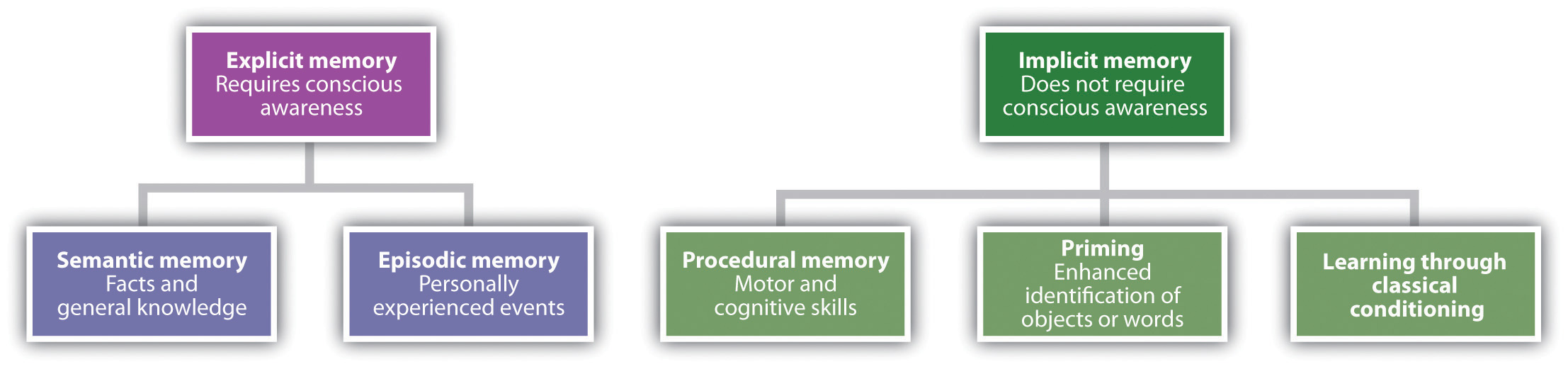
Explicit retentivity is assessed using measures in which the individual being tested must consciously attempt to remember the information. A recall retentivity test is a measure of explicit memory that involves bringing from memory data that has previously been remembered. We rely on our recall memory when we have an essay test, because the exam requires united states to generate previously remembered information. A multiple-choice test is an example of a recognition memory test, a measure of explicit memory that involves determining whether information has been seen or learned earlier.
Your own experiences taking tests will probably atomic number 82 you to agree with the scientific research finding that recall is more difficult than recognition. Retrieve, such every bit required on essay tests, involves two steps: first generating an answer and and so determining whether information technology seems to be the correct one. Recognition, as on multiple-selection test, just involves determining which item from a list seems almost correct (Haist, Shimamura, & Squire, 1992). Although they involve dissimilar processes, retrieve and recognition memory measures tend to exist correlated. Students who do better on a multiple-choice examination volition also, more often than not, do better on an essay examination (Bridgeman & Morgan, 1996).
A third way of measuring retentivity is known as relearning (Nelson, 1985). Measures of relearning (or savings) assess how much more than speedily information is processed or learned when it is studied again after it has already been learned but and so forgotten. If y'all accept taken some French courses in the by, for instance, yous might have forgotten most of the vocabulary y'all learned. But if yous were to work on your French again, yous'd learn the vocabulary much faster the second time effectually. Relearning can be a more sensitive measure out of retentivity than either recall or recognition because it allows assessing retentivity in terms of "how much" or "how fast" rather than just "correct" versus "incorrect" responses. Relearning too allows us to measure memory for procedures similar driving a car or playing a piano piece, as well as memory for facts and figures.
Implicit Retention
While explicit retentiveness consists of the things that we tin consciously report that we know, implicit retentivity refers to cognition that we cannot consciously access. However, implicit memory is even so exceedingly important to usa because it has a direct effect on our behavior. Implicit memory refers to the influence of experience on behavior, even if the individual is not aware of those influences. Equally you lot can see in Effigy eight.ii "Types of Memory", in that location are three general types of implicit memory: procedural retentivity, classical conditioning effects, and priming.
Procedural memory refers to our often unexplainable knowledge of how to do things. When we walk from one place to another, speak to another person in English language, dial a cell telephone, or play a video game, we are using procedural retentivity. Procedural retentiveness allows usa to perform complex tasks, even though we may not be able to explicate to others how we practise them. There is no mode to tell someone how to ride a wheel; a person has to acquire by doing information technology. The thought of implicit memory helps explicate how infants are able to learn. The ability to crawl, walk, and talk are procedures, and these skills are easily and efficiently adult while we are children despite the fact that equally adults we accept no conscious retention of having learned them.
A 2nd type of implicit memory is classical conditioning furnishings, in which we learn, often without try or awareness, to associate neutral stimuli (such equally a sound or a light) with some other stimulus (such as food), which creates a naturally occurring response, such as enjoyment or salivation. The memory for the association is demonstrated when the conditioned stimulus (the sound) begins to create the same response equally the unconditioned stimulus (the food) did before the learning.
The concluding blazon of implicit memory is known as priming, or changes in behavior as a result of experiences that take happened frequently or recently. Priming refers both to the activation of knowledge (e.g., we tin prime number the concept of "kindness" by presenting people with words related to kindness) and to the influence of that activation on behavior (people who are primed with the concept of kindness may act more kindly).
1 mensurate of the influence of priming on implicit retentivity is the word fragment test, in which a person is asked to make full in missing letters to make words. Yous can effort this yourself: Outset, try to complete the post-obit word fragments, but work on each one for only three or four seconds. Do whatever words pop into mind apace?
_ i b _ a _ y
_ h _ s _ _ i _ n
_ o _ k
_ h _ i southward _
Now read the post-obit sentence carefully:
"He got his materials from the shelves, checked them out, and then left the building."
Then attempt again to make words out of the word fragments.
I think you lot might find that it is easier to complete fragments i and 3 as "library" and "volume," respectively, after y'all read the judgement than it was before y'all read it. All the same, reading the sentence didn't really help yous to complete fragments 2 and 4 every bit "doc" and "chaise." This difference in implicit memory probably occurred because every bit you read the judgement, the concept of "library" (and peradventure "book") was primed, even though they were never mentioned explicitly. Once a concept is primed it influences our behaviors, for instance, on discussion fragment tests.
Our everyday behaviors are influenced past priming in a wide diversity of situations. Seeing an advertisement for cigarettes may make us first smoking, seeing the flag of our home country may arouse our patriotism, and seeing a student from a rival school may arouse our competitive spirit. And these influences on our behaviors may occur without our being aware of them.
Research Focus: Priming Outside Sensation Influences Behavior
Ane of the about important characteristics of implicit memories is that they are frequently formed and used automatically, without much attempt or sensation on our part. In one demonstration of the automaticity and influence of priming effects, John Bargh and his colleagues (Bargh, Chen, & Burrows, 1996) conducted a study in which they showed college students lists of v scrambled words, each of which they were to make into a sentence. Furthermore, for half of the research participants, the words were related to stereotypes of the elderly. These participants saw words such as the following:
in Florida retired live people
bingo man the forgetful plays
The other half of the inquiry participants as well fabricated sentences, just from words that had zip to practise with elderly stereotypes. The purpose of this job was to prime number stereotypes of elderly people in memory for some of the participants but not for others.
The experimenters and so assessed whether the priming of elderly stereotypes would have any effect on the students' behavior—and indeed it did. When the research participant had gathered all of his or her belongings, thinking that the experiment was over, the experimenter thanked him or her for participating and gave directions to the closest elevator. And so, without the participants knowing it, the experimenters recorded the amount of time that the participant spent walking from the doorway of the experimental room toward the elevator. Every bit you lot can come across in Figure viii.3 "Results From Bargh, Chen, and Burrows, 1996", participants who had made sentences using words related to elderly stereotypes took on the behaviors of the elderly—they walked significantly more slowly as they left the experimental room.
Figure 8.three Results From Bargh, Chen, and Burrows, 1996
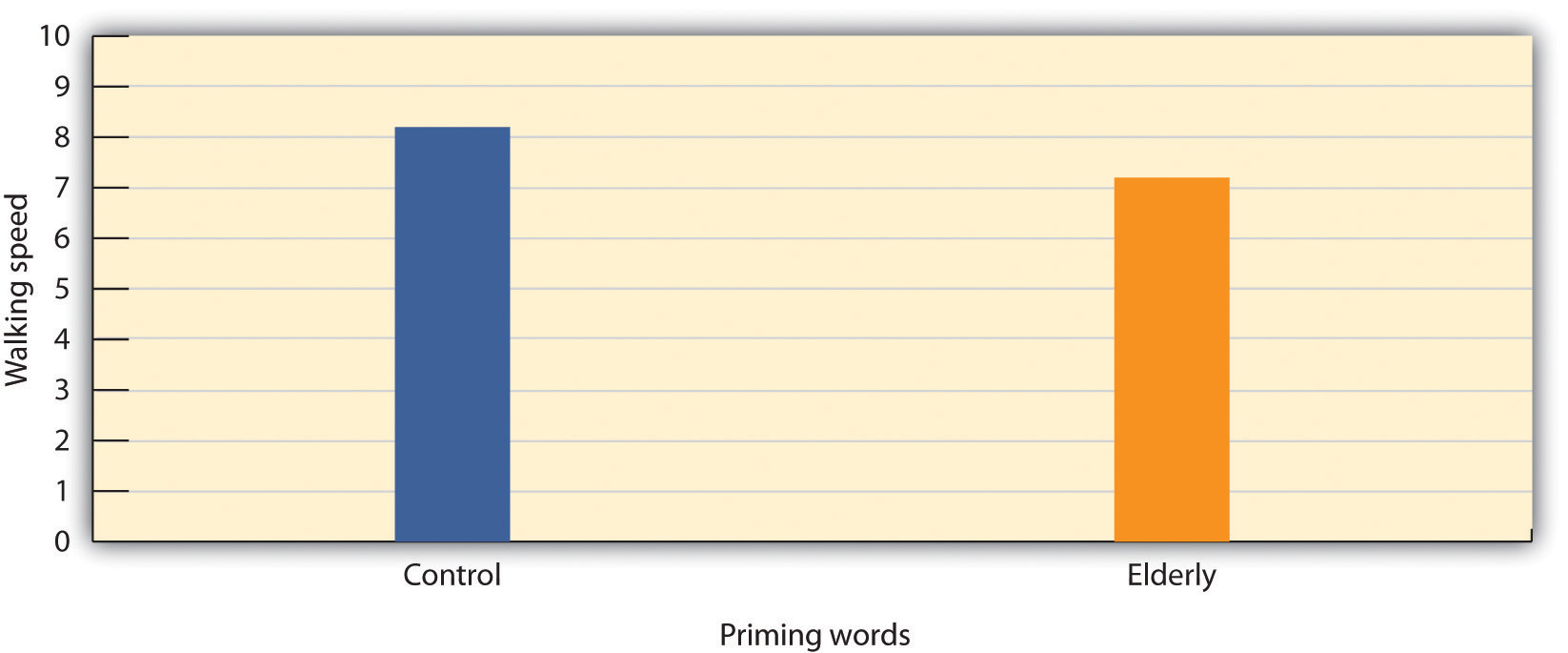
Bargh, Chen, and Burrows (1996) found that priming words associated with the elderly made people walk more slowly.
Adapted from Bargh, J. A., Chen, Chiliad., & Burrows, L. (1996). Automaticity of social behavior: Direct effects of trait construct and stereotype activation on action. Journal of Personality & Social Psychology, 71, 230–244.
To make up one's mind if these priming furnishings occurred out of the awareness of the participants, Bargh and his colleagues asked still some other group of students to complete the priming task and then to indicate whether they thought the words they had used to make the sentences had any relationship to each other, or could perhaps have influenced their behavior in any way. These students had no awareness of the possibility that the words might accept been related to the elderly or could have influenced their behavior.
Stages of Memory: Sensory, Brusque-Term, and Long-Term Memory
Some other style of agreement memory is to recollect about it in terms of stages that describe the length of time that information remains available to us. According to this approach (meet Figure 8.iv "Memory Duration"), information begins in sensory retention, moves to brusk-term memory, and eventually moves to long-term memory. Simply not all information makes information technology through all three stages; most of it is forgotten. Whether the data moves from shorter-duration memory into longer-duration memory or whether it is lost from memory entirely depends on how the data is attended to and candy.
Effigy 8.4 Memory Elapsing
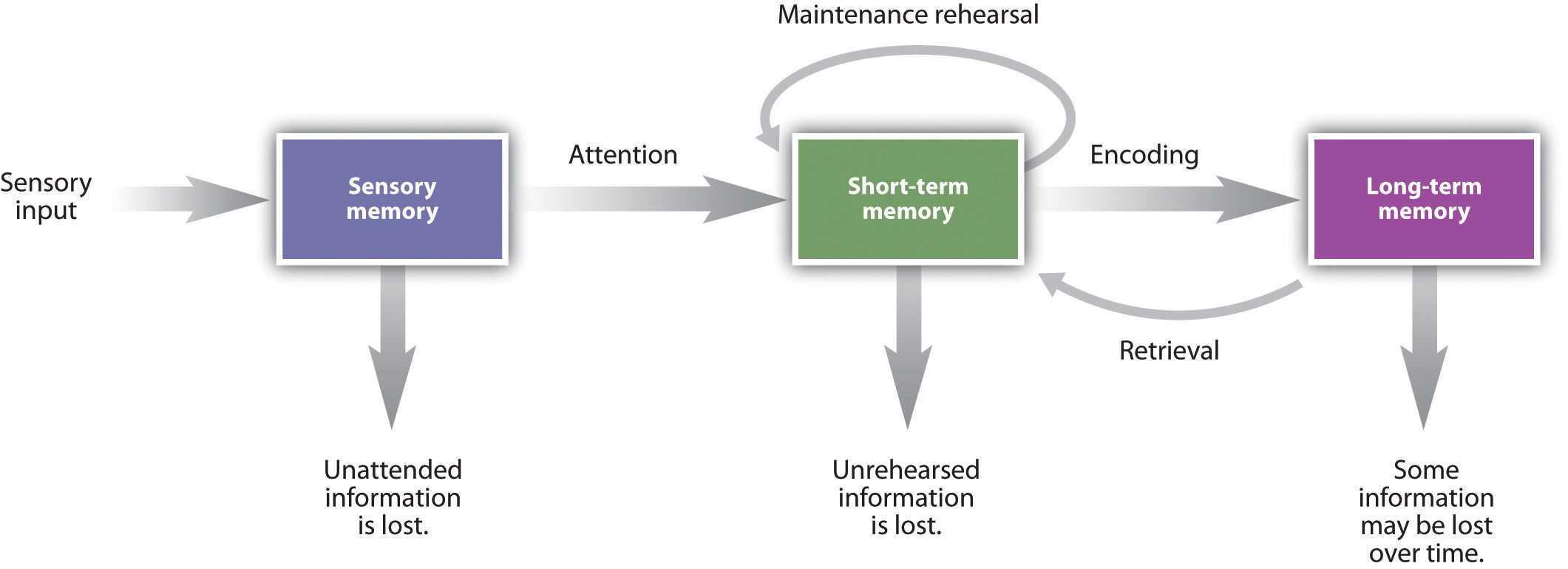
Retention can characterized in terms of stages—the length of time that information remains available to u.s.a..
Adapted from Atkinson, R. C., & Shiffrin, R. One thousand. (1968). Human memory: A proposed organization and its control processes. In Thousand. Spence (Ed.), The psychology of learning and motivation (Vol. ii). Oxford, England: Bookish Printing.
Sensory Memory
Sensory memory refers to the cursory storage of sensory information. Sensory memory is a memory buffer that lasts but very briefly and then, unless information technology is attended to and passed on for more processing, is forgotten. The purpose of sensory memory is to requite the encephalon some time to process the incoming sensations, and to allow us to meet the earth as an unbroken stream of events rather than as individual pieces.
Visual sensory retentivity is known equally iconic memory. Iconic memory was first studied by the psychologist George Sperling (1960). In his inquiry, Sperling showed participants a display of messages in rows, similar to that shown in Effigy 8.five "Measuring Iconic Memory". Nevertheless, the display lasted simply virtually 50 milliseconds (1/xx of a second). Then, Sperling gave his participants a recall test in which they were asked to name all the letters that they could remember. On average, the participants could remember only about one-quarter of the letters that they had seen.
Figure 8.5 Measuring Iconic Memory
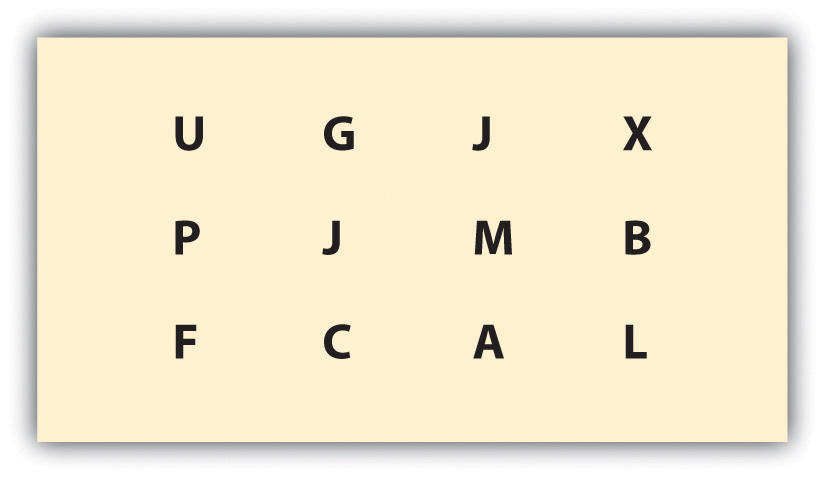
Sperling (1960) showed his participants displays such equally this i for only 1/20th of a second. He found that when he cued the participants to study ane of the iii rows of letters, they could do information technology, even if the cue was given before long afterwards the display had been removed. The research demonstrated the existence of iconic memory.
Adapted from Sperling, G. (1960). The information available in brief visual presentation. Psychological Monographs, 74(11), 1–29.
Sperling reasoned that the participants had seen all the messages merely could call up them only very briefly, making it impossible for them to study them all. To test this idea, in his next experiment he first showed the same letters, but so after the display had been removed, he signaled to the participants to study the letters from either the first, second, or third row. In this condition, the participants now reported almost all the letters in that row. This finding confirmed Sperling's hunch: Participants had access to all of the letters in their iconic memories, and if the task was short enough, they were able to report on the part of the display he asked them to. The "curt enough" is the length of iconic memory, which turns out to be about 250 milliseconds (¼ of a second).
Auditory sensory memory is known as echoic memory. In contrast to iconic memories, which disuse very chop-chop, echoic memories can concluding as long as 4 seconds (Cowan, Lichty, & Grove, 1990). This is user-friendly as it allows y'all—among other things—to remember the words that you lot said at the commencement of a long sentence when y'all go to the end of it, and to have notes on your psychology professor's most recent statement even afterward he or she has finished maxim information technology.
In some people iconic retentiveness seems to last longer, a phenomenon known equally eidetic imagery (or "photographic memory") in which people tin study details of an epitome over long periods of fourth dimension. These people, who ofttimes suffer from psychological disorders such as autism, merits that they can "run across" an image long after it has been presented, and tin frequently report accurately on that paradigm. In that location is as well some show for eidetic memories in hearing; some people study that their echoic memories persist for unusually long periods of fourth dimension. The composer Wolfgang Amadeus Mozart may take possessed eidetic retentiveness for music, considering even when he was very young and had not withal had a peachy deal of musical training, he could listen to long compositions and and so play them back almost perfectly (Solomon, 1995).
Short-Term Memory
Most of the information that gets into sensory memory is forgotten, but information that nosotros turn our attention to, with the goal of remembering it, may laissez passer into short-term retention. Short-term memory (STM) is the identify where small-scale amounts of information can exist temporarily kept for more than than a few seconds but unremarkably for less than one minute (Baddeley, Vallar, & Shallice, 1990). Information in short-term memory is non stored permanently simply rather becomes available for us to process, and the processes that we employ to make sense of, modify, interpret, and shop information in STM are known every bit working memory.
Although it is called "memory," working memory is not a shop of retentivity like STM but rather a set of retentivity procedures or operations. Imagine, for instance, that you are asked to participate in a job such as this one, which is a measure out of working retentiveness (Unsworth & Engle, 2007). Each of the following questions appears individually on a computer screen and and then disappears afterwards y'all answer the question:
Is ten × 2 − 5 = 15? (Respond YES OR NO) And then remember "S"
Is 12 ÷ six − 2 = ane? (Answer Yes OR NO) So call up "R"
Is 10 × 2 = 5? (Answer YES OR NO) And then remember "P"
Is 8 ÷ two − 1 = 1? (Answer YES OR NO) And so remember "T"
Is 6 × 2 − i = 8? (Answer YES OR NO) And then call up "U"
Is 2 × 3 − 3 = 0? (Answer YES OR NO) Then remember "Q"
To successfully reach the task, you have to answer each of the math problems correctly and at the aforementioned fourth dimension call back the alphabetic character that follows the task. And so, subsequently the six questions, you must list the messages that appeared in each of the trials in the correct order (in this instance Southward, R, P, T, U, Q).
To accomplish this difficult task yous need to utilize a multifariousness of skills. You clearly need to use STM, as yous must keep the letters in storage until you are asked to list them. Merely you also need a fashion to make the best use of your available attending and processing. For example, y'all might decide to use a strategy of "echo the letters twice, and then chop-chop solve the next problem, and then echo the messages twice once again including the new 1." Keeping this strategy (or others like information technology) going is the role of working memory's central executive—the role of working retention that directs attending and processing. The fundamental executive will make use of whatever strategies seem to exist all-time for the given chore. For instance, the central executive volition directly the rehearsal process, and at the aforementioned fourth dimension direct the visual cortex to grade an epitome of the list of letters in memory. Yous can see that although STM is involved, the processes that we apply to operate on the material in memory are as well critical.
Brusk-term retentivity is limited in both the length and the amount of information it can hold. Peterson and Peterson (1959) found that when people were asked to remember a list of three-letter strings and then were immediately asked to perform a distracting task (counting astern by threes), the material was speedily forgotten (come across Figure viii.6 "STM Decay"), such that by 18 seconds it was virtually gone.
Effigy 8.half-dozen STM Decay
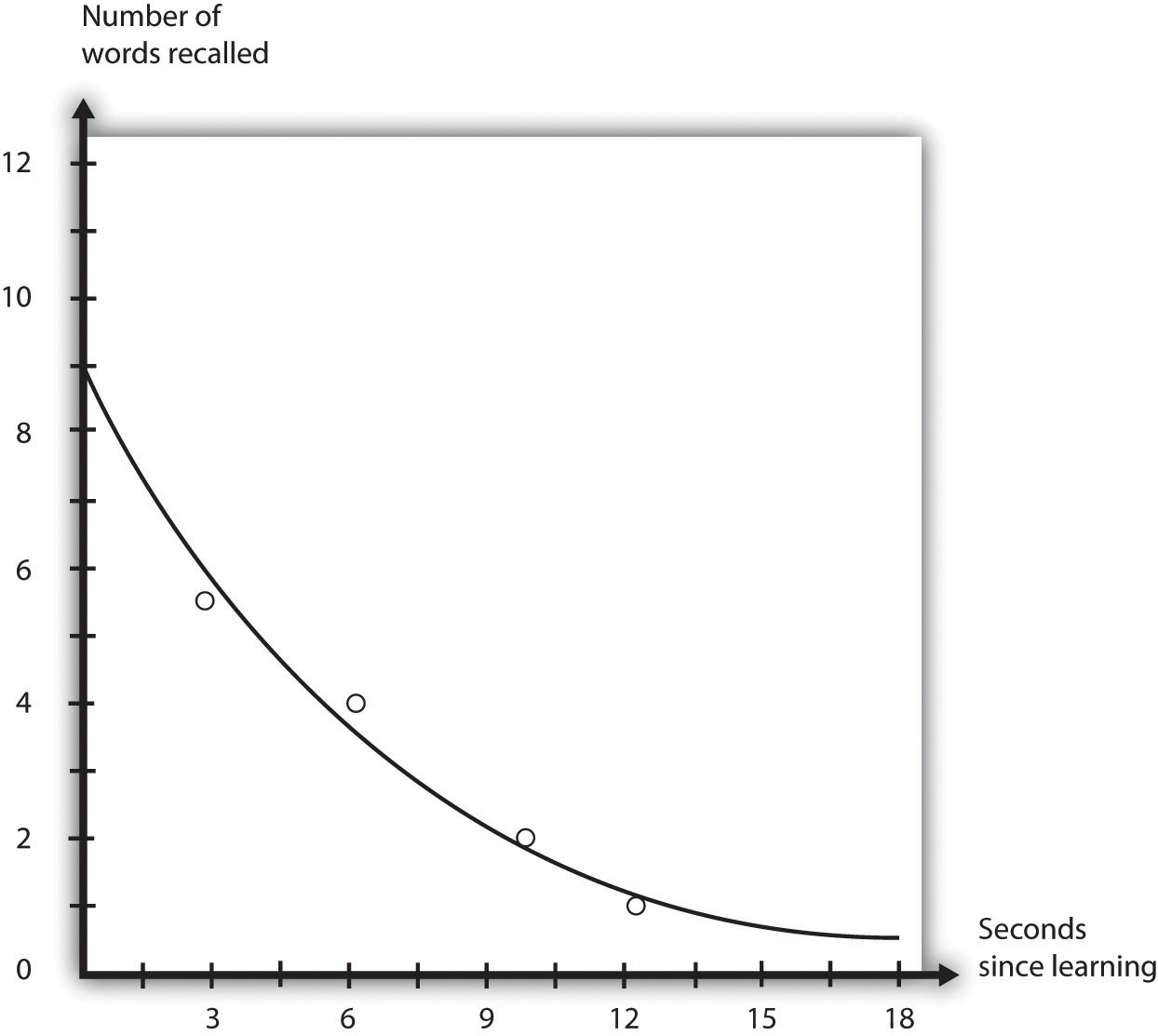
Peterson and Peterson (1959) found that information that was not rehearsed decayed quickly from memory.
Adapted from Peterson, L., & Peterson, K. J. (1959). Short-term retention of individual verbal items. Journal of Experimental Psychology, 58(3), 193–198.
One way to preclude the decay of data from short-term retentivity is to apply working memory to rehearse it. Maintenance rehearsal is the process of repeating information mentally or out loud with the goal of keeping it in memory. We engage in maintenance rehearsal to keep a something that we want to call up (e.g., a person's proper noun, electronic mail accost, or phone number) in mind long enough to write information technology down, use it, or potentially transfer it to long-term retention.
If nosotros go on to rehearse information it will stay in STM until we stop rehearsing it, but in that location is too a capacity limit to STM. Effort reading each of the following rows of numbers, one row at a time, at a rate of near one number each second. And so when you take finished each row, close your eyes and write downwardly every bit many of the numbers as you can remember.
019
3586
10295
861059
1029384
75674834
657874104
6550423897
If you are like the average person, you will have found that on this exam of working memory, known as a digit span examination, you did pretty well up to well-nigh the fourth line, and then you started having trouble. I bet you missed some of the numbers in the concluding three rows, and did pretty poorly on the concluding i.
The digit bridge of most adults is between five and nine digits, with an boilerplate of about 7. The cognitive psychologist George Miller (1956) referred to "seven plus or minus two" pieces of information as the "magic number" in short-term memory. Only if nosotros tin just hold a maximum of about nine digits in brusque-term memory, then how can nosotros remember larger amounts of information than this? For instance, how can we ever remember a 10-digit phone number long enough to punch it?
Ane way we are able to aggrandize our ability to remember things in STM is by using a retention technique called chunking. Chunking is the process of organizing information into smaller groupings (chunks), thereby increasing the number of items that tin be held in STM. For instance, effort to remember this string of 12 letters:
XOFCBANNCVTM
You probably won't exercise that well because the number of messages is more than the magic number of seven.
Now try again with this ane:
MTVCNNABCFOX
Would it help you if I pointed out that the fabric in this string could be chunked into four sets of three letters each? I retrieve information technology would, because then rather than remembering 12 letters, y'all would just have to retrieve the names of iv telly stations. In this case, chunking changes the number of items you have to remember from 12 to only iv.
Experts rely on chunking to assist them process complex information. Herbert Simon and William Chase (1973) showed chess masters and chess novices various positions of pieces on a chessboard for a few seconds each. The experts did a lot better than the novices in remembering the positions because they were able to see the "big picture." They didn't accept to think the position of each of the pieces individually, but chunked the pieces into several larger layouts. Merely when the researchers showed both groups random chess positions—positions that would be very unlikely to occur in real games—both groups did every bit poorly, considering in this situation the experts lost their power to organize the layouts (come across Figure eight.vii "Possible and Impossible Chess Positions"). The same occurs for basketball game. Basketball players recall actual basketball positions much meliorate than practice nonplayers, but only when the positions brand sense in terms of what is happening on the courtroom, or what is probable to happen in the nearly future, and thus can be chunked into bigger units (Didierjean & Marmèche, 2005).
Figure 8.7 Possible and Impossible Chess Positions
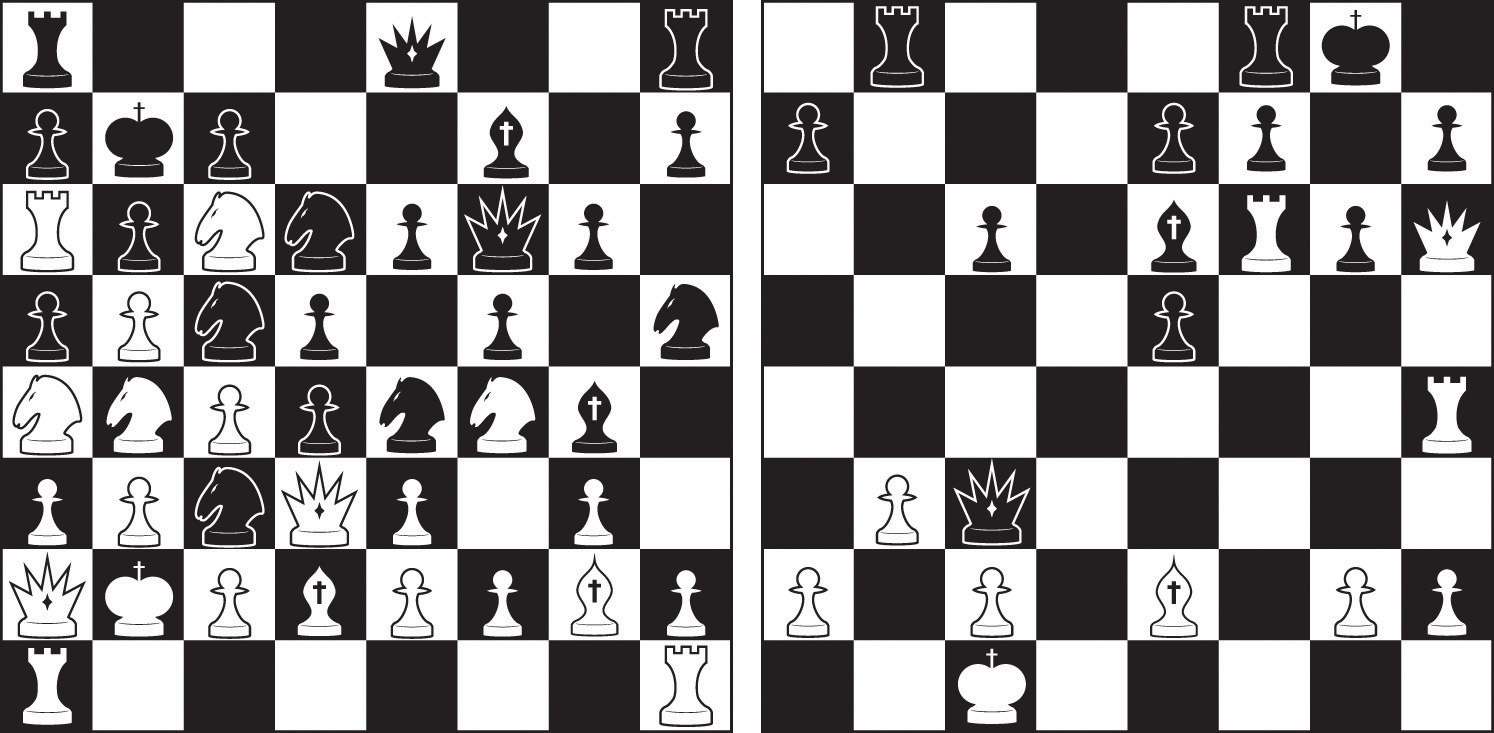
Experience matters: Experienced chess players are able to recall the positions of the game on the correct much better than are those who are chess novices. But the experts practice no better than the novices in remembering the positions on the left, which cannot occur in a real game.
If data makes it past short term-memory it may enter long-term retentivity (LTM), retention storage that can concord information for days, months, and years. The capacity of long-term memory is big, and there is no known limit to what we can remember (Wang, Liu, & Wang, 2003). Although we may forget at least some information subsequently we acquire it, other things volition stay with us forever. In the adjacent section nosotros volition hash out the principles of long-term memory.
Key Takeaways
- Retentiveness refers to the ability to store and think information over fourth dimension.
- For some things our memory is very good, but our agile cognitive processing of information assures that memory is never an exact replica of what we take experienced.
- Explicit memory refers to experiences that can be intentionally and consciously remembered, and it is measured using recall, recognition, and relearning. Explicit memory includes episodic and semantic memories.
- Measures of relearning (also known every bit savings) appraise how much more quickly information is learned when it is studied again afterwards it has already been learned but then forgotten.
- Implicit memory refers to the influence of experience on behavior, even if the individual is not enlightened of those influences. The iii types of implicit retention are procedural retention, classical conditioning, and priming.
- Data processing begins in sensory memory, moves to brusque-term retentiveness, and eventually moves to long-term retention.
- Maintenance rehearsal and chunking are used to keep information in short-term retention.
- The chapters of long-term retentiveness is large, and there is no known limit to what we tin can retrieve.
Exercises and Critical Thinking
- Listing some situations in which sensory memory is useful for you. What do you lot recollect your experience of the stimuli would be like if you lot had no sensory memory?
- Describe a state of affairs in which you demand to employ working memory to perform a task or solve a problem. How do your working retention skills help you?
References
Atkinson, R. C., & Shiffrin, R. 1000. (1968). Human retentivity: A proposed system and its command processes. In G. Spence (Ed.), The psychology of learning and motivation (Vol. 2). Oxford, England: Bookish Press.
Baddeley, A. D., Vallar, Thou., & Shallice, T. (1990). The development of the concept of working memory: Implications and contributions of neuropsychology. In G. Vallar & T. Shallice (Eds.), Neuropsychological impairments of short-term memory (pp. 54–73). New York, NY: Cambridge University Press.
Bargh, J. A., Chen, M., & Burrows, L. (1996). Automaticity of social behavior: Direct effects of trait construct and stereotype activation on activity. Periodical of Personality & Social Psychology, 71, 230–244.
Bridgeman, B., & Morgan, R. (1996). Success in college for students with discrepancies between performance on multiple-choice and essay tests. Journal of Educational Psychology, 88(2), 333–340.
Cowan, N., Lichty, Due west., & Grove, T. R. (1990). Properties of memory for unattended spoken syllables. Journal of Experimental Psychology: Learning, Retentivity, and Cognition, 16(2), 258–268.
Didierjean, A., & Marmèche, E. (2005). Anticipatory representation of visual basketball scenes by novice and expert players. Visual Cognition, 12(2), 265–283.
Haist, F., Shimamura, A. P., & Squire, L. R. (1992). On the relationship between recall and recognition retention. Journal of Experimental Psychology: Learning, Retention, and Cognition, 18(four), 691–702.
Miller, G. A. (1956). The magical number seven, plus or minus ii: Some limits on our capacity for processing information. Psychological Review, 63(2), 81–97.
Nelson, T. O. (1985). Ebbinghaus's contribution to the measurement of retention: Savings during relearning. Journal of Experimental Psychology: Learning, Retention, and Cognition, 11(3), 472–478.
Peterson, 50., & Peterson, M. J. (1959). Short-term memory of individual verbal items. Journal of Experimental Psychology, 58(iii), 193–198.
Simon, H. A., & Chase, W. Chiliad. (1973). Skill in chess. American Scientist, 61(4), 394–403.
Solomon, M. (1995). Mozart: A life. New York, NY: Harper Perennial.
Sperling, G. (1960). The information available in brief visual presentation. Psychological Monographs, 74(11), 1–29.
Unsworth, N., & Engle, R. W. (2007). On the partitioning of short-term and working retention: An test of uncomplicated and complex span and their relation to higher club abilities. Psychological Bulletin, 133(six), 1038–1066.
Wang, Y., Liu, D., & Wang, Y. (2003). Discovering the capacity of human memory. Brain & Listen, 4(two), 189–198.
Source: https://open.lib.umn.edu/intropsyc/chapter/8-1-memories-as-types-and-stages/
0 Response to "Measure of Memory That Assesses the Amount of Time Saved When Learning Material Again"
Post a Comment